
The Unavoidable Conclusion
Christian God is Not Real

The Unavoidable Conclusion
A Unified Argument Against the Christian God
The Christian God is defined by three attributes held simultaneously: omnipotence, omniscience, and omnibenevolence — all-powerful, all-knowing, and perfectly good. These three, taken together, are internally self-defeating. If God is all-knowing, he knew before creating humans that they would suffer and sin. If he is all-powerful, he could have created them otherwise. If he is perfectly good, he would have. The fact that he did not — or that he created the conditions guaranteeing suffering anyway — means at least one of those three attributes must be false.
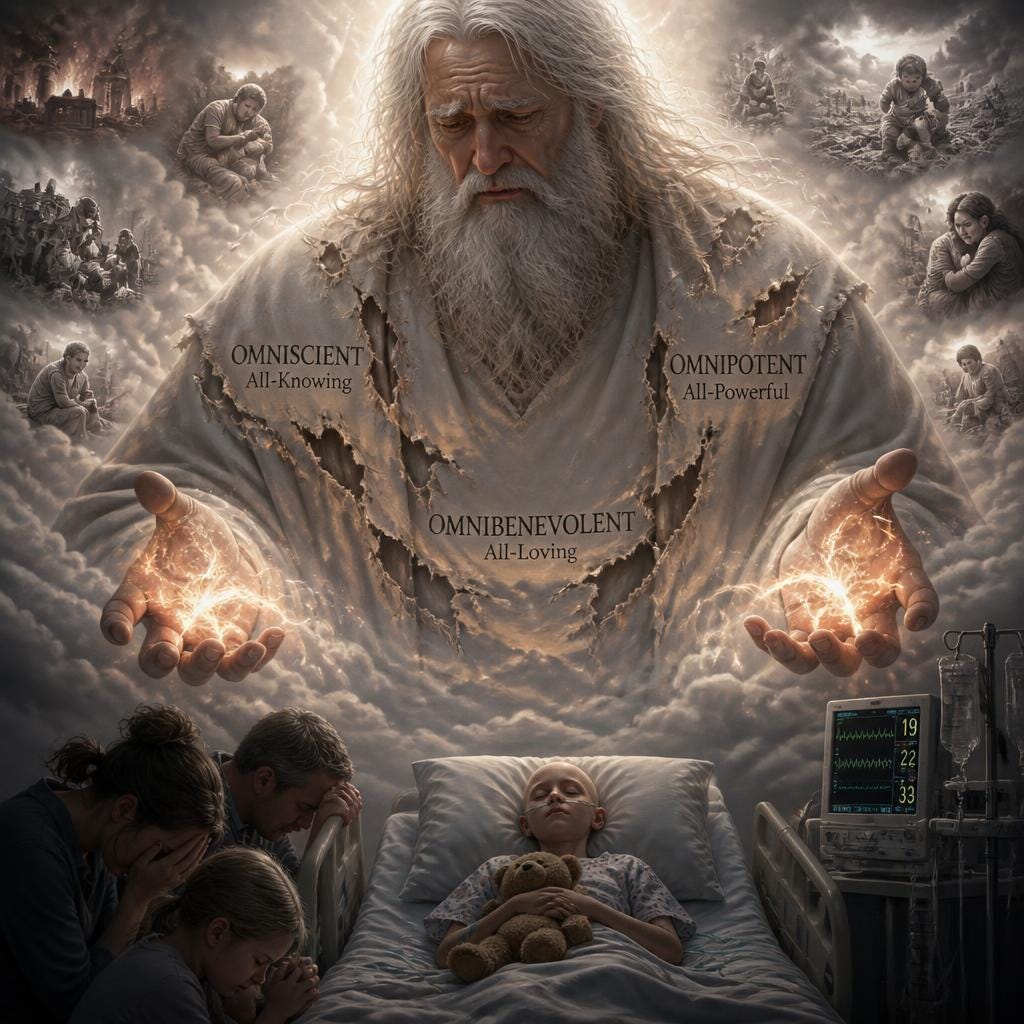
This is the Problem of Evil, and its logical form has resisted resolution for over two thousand years.
Plantinga argues that God cannot create free beings who always choose good, but this merely shifts the burden: an omnipotent God could have created beings with different natures, beings for whom the free choice of good was not in competition with the free choice of evil. More fundamentally, it says nothing about natural evil — earthquakes, childhood cancer, congenital disease — which involves no human freedom whatsoever. Swinburne’s soul-making argument, that suffering is necessary for moral development, requires that an omnipotent God could not develop moral character through any other mechanism — a claim that is simply asserted, not demonstrated, and that fails immediately against the suffering of infants and animals who develop no character from their pain at all. Every attempted solution either surrenders one of the three divine attributes or introduces assumptions more implausible than the problem it claims to solve. The logical structure does not bend. It breaks.
The Christian God is also a specific historical claim, not merely a philosophical one. The Bible presents miracles as literal events — the sun stopping, global floods, resurrections after decomposition. Every one of these violates laws of physics, chemistry, and biology so fundamental that no credible evidence has ever supported any comparable event in recorded history. Prayer studies conducted under rigorous scientific conditions show no measurable effect. The universe behaves, in every observable way, exactly as it would if no supernatural agent were acting upon it — with total consistency, total indifference, and zero detectable intervention. The God who allegedly stopped the sun, parted the sea, and raised the dead has not produced a single documented miracle in the age of cameras, hospitals, and double-blind studies. The silence is not mysterious. It is diagnostic.
Finally, Christianity emerged in a specific time and place, among people who believed in demon possession, a three-tiered flat earth, and disease as divine punishment. Every culture independently invents gods that reflect its own values, fears, and power structures — and Christianity is no exception. Cognitive science now explains religious belief as a predictable byproduct of evolved mental mechanisms: brains that survived by detecting agency everywhere. We are pattern-seeking creatures who see faces in clouds and intentions in storms. The Christian God fits perfectly as a human invention shaped by the anxieties of a specific people in a specific century. He does not fit at all as a demonstrated reality.
The Bible makes specific, concrete claims about the physical structure of the universe that are flatly wrong. Isaiah 11:12 and Revelation 7:1 refer to the four corners of the earth, and Psalm 93:1 and 1 Chronicles 16:30 insist the earth is firmly established and cannot be moved — yet the earth is a sphere traveling at 67,000 miles per hour around the sun. Genesis 1:6–8 describes a solid dome called the firmament separating waters above the sky from waters below — no such structure exists. Genesis 1:3–19 places the creation of earth before the creation of the sun, when in reality the sun predates the earth by approximately 500 million years. Revelation 6:13 and Matthew 24:29 describe stars falling to earth like figs from a tree — stars are millions of times larger than earth, and such an event would be instantaneous annihilation, not a visible spectacle in the sky. These are not edge cases or obscure verses. They are foundational cosmological descriptions in the text, and every one of them is wrong.
The biological claims are equally precise and equally wrong. Genesis 2:7 describes a human being assembled instantaneously from dust, contradicting four billion years of evolutionary biology. Genesis 1–2 requires all human genetic diversity to trace back to exactly two people roughly 6,000 years ago — population genetics makes this mathematically impossible, as a viable founding population requires thousands of individuals. Leviticus 11:13–19 classifies bats as birds — bats are mammals. Leviticus 11:20–23 describes insects as having four legs — every insect on earth has six. These are not metaphors. They are stated classifications of the natural world, and they are wrong in ways that any careful observer could have detected.
The geological and archaeological errors are equally damning. Genesis 7:19 claims a flood covered every mountain on earth simultaneously, yet global geological records, ice cores, and sediment layers show no such event — and ancient civilizations in Egypt, Mesopotamia, and China continued uninterrupted through the supposed flood period with no break in their records, directly contradicting Genesis 10–11’s claim that all humanity descends from Noah roughly 4,000 years ago. Joshua 6 describes the walls of Jericho falling around 1400 BC — archaeology has established that Jericho had no walls and was barely occupied during that period.
The Noah narrative is not merely strained by science — it is falsified by the geographic distribution of species with mathematical precision. If every animal on earth descended from pairs deposited on Mount Ararat in modern Turkey roughly four thousand years ago, the current distribution of life is completely inexplicable. Kangaroos, koalas, wombats, and platypuses exist exclusively in Australia. Kiwi birds exist exclusively in New Zealand. Lemurs exist exclusively in Madagascar. These species cannot survive outside their specific climatic zones, cannot cross open ocean, and leave zero fossil trace along any migration route from the Middle East to their current habitats. The biogeographical distribution of life makes complete and precise sense through evolution, continental drift, and geographic isolation over millions of years. It makes no sense whatsoever if every species originated from a single point four thousand years ago.
Finally, 1 Kings 7:23 describes a circular basin ten cubits in diameter and thirty cubits in circumference, giving a value of pi equal to exactly 3 — the actual value is 3.14159. The error is small in appearance but deeply revealing: any architect or mathematician of even modest sophistication knows the difference. A God who is the source of all mathematical truth should know pi.
Christianity cannot be defended using Christianity, yet that is the only defense Christians ever offer. When pressed, they produce Bible verses, Christian theologians, and church authorities — none of which constitute external evidence for the claims being made. This is a logical fallacy so fundamental it predates the scientific method: you cannot prove an argument using elements of the argument itself. If the proposition is that God is real and the Bible is true, then the Bible says so is not evidence — it is the very claim under dispute, restated. Every field of human knowledge — law, science, medicine, history — operates on the principle that a claim requires independent verification. A belief system that treats its own text as proof of its own text would be rejected as elementary logical failure in any other domain of inquiry.
The New Testament — the supposed foundation of Christian morality — contains commandments that no practicing American Christian follows. Paul explicitly commands women to remain silent in church and submit entirely to their husbands. The New Testament endorses slavery in unambiguous terms, instructing servants to obey cruel masters as an act of Christian witness. Jesus himself commands his followers to abandon their families, sell all possessions, give everything to the poor, and never accumulate wealth — stating explicitly that it is easier for a camel to pass through the eye of a needle than for a rich man to enter heaven. Every prosperity gospel preacher, every megachurch pastor with a private jet, every Christian politician who votes to protect billionaires is living in direct violation of these explicit commands. Meanwhile, the same Christians who ignore these verses cite Leviticus to condemn homosexuality — while simultaneously participating daily in a financial system built entirely on usury, which the Bible condemns in Exodus, Leviticus, Deuteronomy, and Ezekiel. This is not faith applied selectively under pressure. It is a belief system retrofitted around pre-existing cultural preferences, with scripture deployed as a weapon against others and ignored entirely when it becomes personally inconvenient.
The Bible’s own text contradicts the Christian definition of God from within. Exodus 20:3–5 — the foundational commandments — states that God forbids worship of other gods before him, then in verse 5 describes himself explicitly as a jealous God. Both clauses are theologically catastrophic. The first implies the existence of other gods, which directly contradicts monotheism — you do not need to forbid worship of entities that do not exist. The second describes God as jealous, which is an emotion generated by insecurity, ego, and the fear of loss. An omnipotent being has nothing to lose. An omnibenevolent being is not governed by wounded pride. A jealous God is by definition a limited God — one with emotional needs, territorial instincts, and a requirement for validation from the beings he supposedly created. This is not the description of an infinite, perfect, unconditional moral authority. It is the psychological profile of a controlling personality who demands exclusive loyalty and punishes deviation across generations — verse 5 specifies punishment extending to the third and fourth generation of those who disobey. The God described in the foundational commandments of the Bible is not all-good. He is, by his own account, jealous, punitive, and tribalistic.
Christianity’s central social claim is that it is the foundation of morality and that without it civilization collapses. The data says otherwise. Christianity has been in measurable decline in the West for fifty years — dropping from 90% of American adults in 1972 to 63% in 2021, with only 49% of Millennials and Gen Z identifying as Christian at all. During this same period of rapid secularization, violent crime in the United States dropped by approximately half. The countries consistently ranked as the safest, most peaceful, and most equitable on earth — Sweden, Norway, Denmark, Japan — are among the least religious nations in human history. Meanwhile the American Bible Belt, the most densely Christian region of the country, leads the nation in violent crime, poverty, teen pregnancy, divorce, and infant mortality. The premise that Christianity produces morality is not only unproven — it is empirically inverted by the available evidence.
The most common non-theological defense of Christianity is also the weakest: that it must contain truth because it has endured for two thousand years and been adopted by billions of people. This argument proves nothing about truth and everything about power. The Egyptian religious system lasted over three thousand years — longer than Christianity has existed — and is now extinct.
Roman planetary religion sustained one of history’s most successful civilizations for a millennium before being politically replaced by Christianity, not intellectually defeated by it. Truth is not determined by longevity, and it is not determined by the number of believers. The geocentric model of the solar system was held by virtually every educated person on earth for over a thousand years and was completely wrong. Bloodletting was standard medical practice for two millennia and killed patients. Majority belief sustained over long periods of time is evidence of cultural power and institutional enforcement — nothing more. Christianity spread primarily through the military force of European empires, not through the persuasive superiority of its ideas. It is currently declining in every Western nation where that military enforcement has ended. When the coercion stops, the numbers fall. That is not the trajectory of a discovered truth. It is the trajectory of a maintained one.
Christianity as it exists today is not the religion of Jesus. It is a Roman imperial construct engineered for political consolidation. For its first three centuries it was a persecuted minority cult. In 325 CE, Emperor Constantine convened the Council of Nicaea not for spiritual reasons but to unify a fragmenting empire under a single doctrine — suppressing Gnostics, Arians, and dozens of other early Christian sects that did not serve imperial purposes. In 380 CE, Emperor Theodosius made Nicene Christianity the compulsory state religion of Rome. What survived this process was not the teachings of a humble Jewish itinerant preacher but a power structure — hierarchical, wealth-accumulating, violence-endorsing — that bears his name while violating virtually every principle attributed to him. December 25 was established as the birthday of the Invincible Sun by Emperor Aurelian in the third century, as part of existing Roman winter solstice celebrations. The Christian church formally adopted that date in 336 CE. The traditions now associated with Christmas — the evergreen tree, the exchange of gifts, the twelve-day feast, the candles — predate Christianity entirely and derive from Saturnalia, Yule, and other pre-Christian observances. The most culturally central event on the Christian calendar is a Roman pagan holiday wearing a different name.
None of these arguments require faith in an alternative worldview. None of them ask the reader to accept a different God, a different scripture, or a different cosmology. They require only the consistent application of the same standards of evidence and logic that Christians themselves apply to every other claim they evaluate in their daily lives. The Christian who rejects evolution accepts the germ theory of disease. The Christian who insists on a 6,000-year-old earth flies in airplanes that depend on physics he denies. The Christian who prays for miracles takes antibiotics. The standard they apply to their own religion is not humility before mystery. It is a special exemption, granted to one set of claims and one set of claims only, for reasons that have everything to do with culture, identity, and power, and nothing to do with evidence. When that exemption is removed — when Christianity is held to the same evidentiary standard as any other historical claim, any other cosmological model, any other moral system — it does not merely weaken. It collapses entirely, block by block, from the inside out.
Further reading:
The Miller-Urey Experiment (1953): This foundational study demonstrated that under simulated conditions resembling early Earth’s atmosphere, inorganic compounds could spontaneously form complex organic building blocks, including amino acids, the fundamental components of proteins. [1]
Presence of Organic Building Blocks in Space: Organic molecules and amino acids have been discovered in interstellar clouds and meteorites, establishing that the raw ingredients for life are naturally abundant throughout the universe. [1, 2, 3, 4, 5]
Spontaneous Assembly of Cell Structures: Phospholipids naturally and spontaneously self-assemble into lipid bilayers in water, providing the basic boundary structures required to isolate biological components and form primitive cells. [1, 2]
The RNA World Hypothesis: Scientists have proven that RNA can act both as genetic information and as a catalyst to drive chemical reactions, presenting a plausible pathway for how early life could store genetic data and reproduce without the complex DNA/protein systems found in life today. [1, 2]
Rapid Emergence of Life: Geological and paleontological evidence indicates that life appeared very early in Earth’s history, not long after the planet cooled, suggesting that the transition from non-life to life may be a rapid and probable process under the right conditions. [1, 2, 3, 4]