
Shamballah
a novel idea

SHAMBHALA
A Golden Door Novel
Nick Stanifer
This story takes place in the contemporary world, in the psychological universe of Owen Marsh, a successful novelist whose published work Behind The Golden Door exists within the Golden Door universe. Shambhala is the story of a man whose interior world has been systematically colonized by damage — generational, institutional, and predatory — and of the female therapist who enters that world in a race against his annihilation.
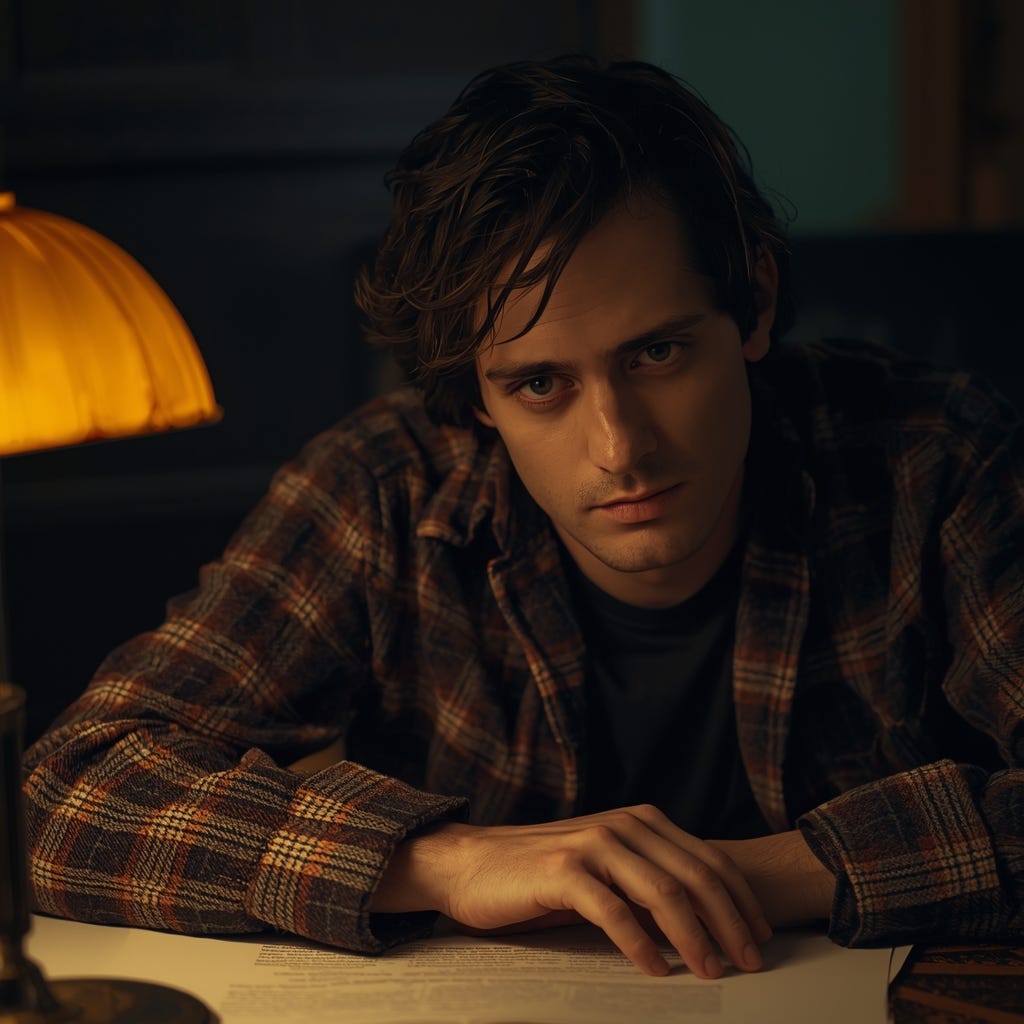
Owen Marsh is a neurodivergent writer in his early forties, the son of Steven Marsh, an Army Colonel who abandoned his family for other women, leaving Owen’s mother Miriam catatonic and lost to a drug called Amaranth, which produces overwhelming hallucinogenic visions and renders its users permanently interior — present in body, absent in every way that matters. Owen grew up watching his mother dissolve into involuntary inner worlds while he constructed voluntary ones. Two different responses to the same original wound.
Owen has two sisters. Vivian, solar and direct, who never stopped fighting for him openly. And Mira, subterranean and quiet, who carries the family damage most internally and knows things she cannot say in language.
In the 1980s, a fire breaks out at a military hangar where Steven Marsh has been involved in the classified back-engineering of recovered alien craft. Because of the sensitivity of the project and the limited clearance of its personnel, Steven is forced to temporarily relocate several of the ships to his own property. Young Owen — barely old enough to understand what he is looking at — sneaks into one of the craft in the backyard. The ship is psychically operated. It interfaces with Owen’s pure unfiltered child consciousness and downloads something vast and permanently altering. This is the origin moment of Owen’s neurodivergence, his extraordinary imagination, his lifelong fixation on Shambhala and hollow earth mythology, and his status as a classified government target. It is also the most significant and most buried memory of a part of Owen called Seed — a little boy who holds everything Owen was before the damage came and covered it.
Owen’s psyche is populated by Types — internal figures generated by decades of accumulated damage, each serving a function in the architecture of a compromised interior world.
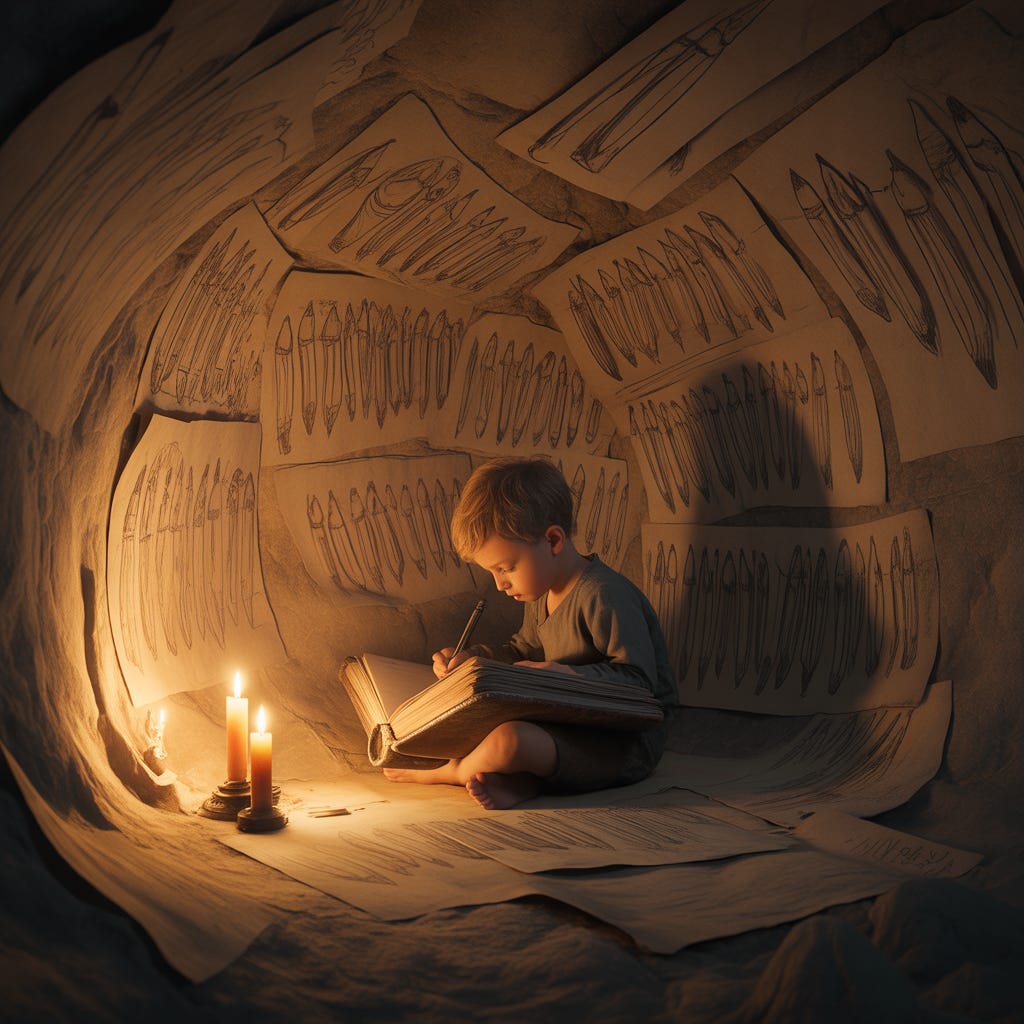
Seed is an Exile. A little boy with boundless imagination frozen at the age of Owen’s original wounds, sitting in the deepest most inaccessible part of Owen’s inner world surrounded by drawings on walls, half built impossible structures, and stories scratched into every available surface. Seed is the pure creative source from which Behind The Golden Door and everything Owen has ever written originates. He also holds the memory of the UFO contact — cosmic wonder that nobody believed, buried under generations of damage. Seed knows what is coming. He has been quietly writing his escape vessel, pouring himself into Behind The Golden Door with the deliberate intention of jumping ship before Owen’s annihilation and surviving forever in the psyches of every reader who opens the book. Victoria can kill Owen’s body. She cannot reach the imagination of everyone who reads Behind The Golden Door.
Coral is a Firefighter. Vivid, desperate, coral-colored against the grey of Owen’s suppressed interior world, more alive than anything else in the landscape. Coral knows he only exists as long as Owen imagines him. When Owen’s annihilation becomes imminent, Coral straps a bomb to Owen’s body and walks into a bank, attempting to generate the money that would remove Victoria’s financial motive for killing him. Not noble. Survival. What Coral does not know is that Victoria has been cultivating his desperation for years like tending a weapon, steering his logic toward this exact catastrophic conclusion from the beginning.
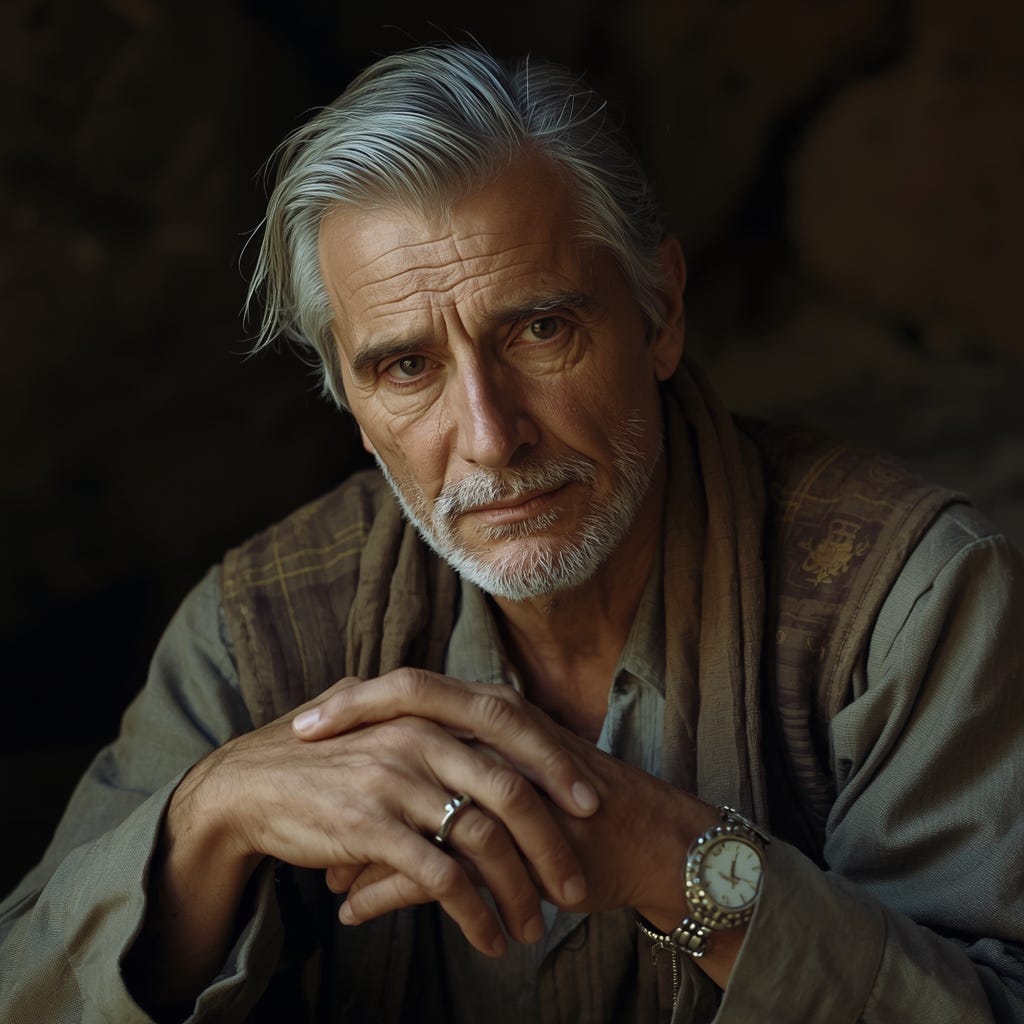
Caspian Absalom appears throughout the story as Owen’s most trusted friend and mentor in the real world — a Roerich-like mystic who claims firsthand knowledge of Shambhala and the hollow earth, who speaks of intergalactic councils, nuclear suppression, and alien craft with the quiet authority of lived experience. He opens the story by trying to convince Owen not to seek therapy. Men don’t do that. Emotions are weakness. Women have feelings. Men are supposed to be strong. Caspian’s opposition to therapy is existential — because if Owen heals, Caspian’s function dissolves. He is revealed to be a Type, Owen’s own psyche constructing the wise father figure Steven Marsh never was, built from decades of paternal hunger and the alien psychic contact from the hangar fire. Every conversation Owen believed he was having with an external source of ancient wisdom was Owen talking to himself through the only face he could trust.
Misty Meanor is a female presence drifting through Owen’s inner world at its thresholds — vaporous, obscured, impossible to fully see through. Her name carries misdemeanor underneath it, the cultural diminishment of male emotional damage, the minor infraction nobody takes entirely seriously. She is Owen’s wounded interior feminine, distorted first by Miriam’s disappearance into Amaranth and then further corrupted by Victoria. Something that was meant to be a source of internal wisdom and integration became instead a drifting, half-present figure that Owen can never quite reach or see clearly. She exists at the boundary between what Owen can feel and what he has been told he is not allowed to.
Whoopsy Daisy is Victoria’s manifestation in the Fantasy World. Not a spider — that is how Owen’s therapist Nora sees Victoria from outside. From within Owen’s experience, Victoria moves through his inner landscape as Whoopsy Daisy — whimsical, colorful, bouncy, apparently harmless. The kind of character from a children’s story that nobody fears and nobody sees coming. The narcissist’s true operational form. Damage delivered with a smile and a shrug. Owen let her into everything because she seemed like Whoopsy Daisy. She has spider silk running through the entire interior world and Owen never noticed because she never looked dangerous.
The Self is the calm undamaged center that exists always intact underneath everything. In Owen’s case it is connected to the original UFO contact — the moment before the damage calcified around the wonder. The hidden kingdom. Shambhala itself. The masculine identity that Victoria has been systematically dismantling, waiting in an interior kingdom to be reclaimed. What Nora is ultimately seeking. What Seed has always known how to find.
Owen believes the government agents pursuing him for his classified UFO knowledge are actually Varek — enforcers from the hollow earth, agents of an intergalactic council that took control of world governments in the 1950s when nuclear experimentation threatened planetary annihilation. In the real world Owen sees ordinary surveillance. In his interior framework he sees Varek. Whether Varek is purely a psychological projection onto real external threat, or something genuinely more than that, remains the story’s central unresolvable question.
In the Fantasy World — Owen’s written fictional universe, the landscape of Behind The Golden Door — Owen appears as an explorer seeking Shambhala, the hidden Tibetan kingdom of perfected warrior beings inside the Earth, the place of pure masculine sovereign wisdom that will emerge at the end of a dark age to restore order. What begins as Owen’s novelist imagination and conspiracy fixation gradually reveals itself as the map of his own psyche. Shambhala is The Self. The masculine identity Victoria has been dismantling. The hidden kingdom that was always interior.
Nora Hale is Owen’s therapist. Aries. Active sign energy — direct, clear-sighted, the force that moves toward rather than drawing toward itself. She enters Owen’s life as his therapist and gradually realizes she is not just treating complex trauma accumulated across a damaged life. She is racing against a murder plot while navigating one of the most extraordinary interior landscapes she has ever encountered.

Victoria Thorn Marsh is Owen’s wife. Passive sign, Capricorn — cold long game ambition, patient resource acquisition, a plan measured in years of careful execution. Her public persona is passionate eco-activist, beautiful and articulate and apparently concerned with the living world. Privately she is executing a calculated plan to collect on a large life insurance policy Owen’s publisher has taken out on him. She is the spider who does not chase — who constructs conditions and waits. She may or may not be an agent of Varek. This question is never resolved.
The story operates as a commentary on active and passive signs in astrology — Victoria embodying the predatory shadow of passive sign energy, drawing inward and consuming, Whoopsy Daisy as her perfect operational disguise. Nora embodying active sign energy at its most constructive — the warrior who enters directly and moves through the interior world with purpose and clarity. The feminist argument is made structurally rather than through dialogue: patriarchal conditioning builds the vulnerability in men, narcissistic predators find it and exploit the architecture society already constructed, and the radical healing act is a woman entering a man’s inner world to restore what the system took.
The story opens with Caspian Absalom trying to convince Owen not to seek therapy. Owen goes anyway — something has frightened him badly enough to override his most trusted voice for the first time.
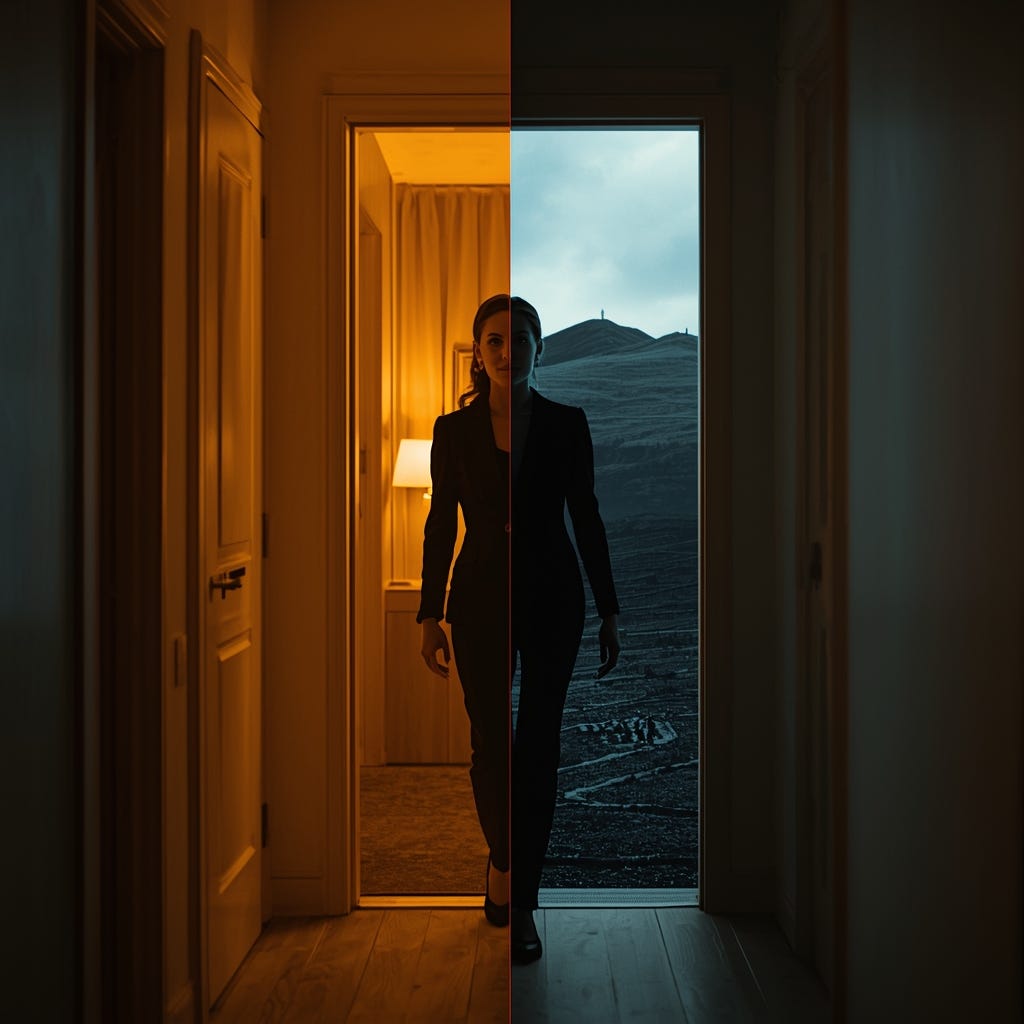
Nora begins navigating Owen’s layers. The Fantasy World appears initially as rich novelist imagination — an explorer moving through a vast mysterious landscape toward the hidden kingdom of Shambhala, guided by the mystical Caspian Absalom. Whoopsy Daisy moves freely through it, bouncy and colorful, trailing something that might be silk if you looked in the right light. Misty Meanor drifts at the thresholds. The real world shows a functional literary marriage. Government agents appear at the edges. Owen mentions Varek carefully, watching Nora’s reaction.
As therapy deepens the layers begin bleeding into each other. Coral emerges at the margins — vivid, desperate, aware of his own constructed nature in ways that disturb him. Seed is glimpsed in the deepest part of the inner world, a little boy surrounded by drawings and half-built impossible structures, quietly writing something in the dark.
The hangar fire backstory emerges through multiple channels simultaneously — Owen’s fragmented childhood memories, Caspian’s hollow earth narrative, the Fantasy World explorer’s descent toward the Earth’s interior. What seemed like conspiracy theory acquires the texture of something real.
Victoria’s plan accelerates. We see her privately — the spider without the Whoopsy Daisy performance. The web she has been building around Owen for years becomes visible in its full architectural complexity. Her deliberate cultivation of Coral toward catastrophic action reveals itself in chilling increments.
A flashback sequence arrives — fragmented, non-linear, assembled across multiple chapters. A private moment between Owen and Victoria in which she appears to gaslight him into believing she is Varek. Whether she is weaponizing his psychological framework to terrorize and control him, or actually revealing what she is in a moment of calculated cruelty, or both simultaneously — the scene is constructed so that no reading can be confirmed or dismissed. It is the hinge of the entire story.
Nora and Victoria encounter each other in a grocery store — ordinary public space, apparently chance. Victoria performing warmth and concern, subtly positioning herself as Owen’s greatest ally, preemptively framing his perceptions as symptoms. Nora maintaining professional neutrality while internally recognizing the spider beneath Whoopsy Daisy’s colors. The most charged scene in the real world. Two women who understand everything and can acknowledge nothing.
The Caspian reveal arrives through the deepening therapy. Owen’s most trusted advisor, his Roerich mystic, his hollow earth guide — is Owen talking to himself. The father he needed wearing the face of ancient wisdom. The revelation is devastating not because Caspian was malicious but because he was desperate and lonely and entirely Owen’s own creation.
Coral’s desperation reaches its conclusion. The money solution. The bomb.
Nora and Victoria find themselves in the same store when the bank incident erupts across the television news. Owen. Coral wearing Owen’s body. The bomb. The demand for money.
Victoria watches knowing she built this moment from the beginning.
Nora understands in a single terrible instant the full architecture of what Victoria has constructed.
Both women move toward the scene. For completely different reasons.
The bomb goes off.
Owen dies.
In the aftermath the story’s central ambiguity becomes permanent. Was Victoria Thorn Marsh a predatory narcissist who executed a calculated murder for financial gain? Or was she Varek — sent specifically to eliminate a man whose childhood psychic contact with alien craft made him a classified liability to an intergalactic management structure that has been running human governments since the 1950s?
Both explanations fit every fact perfectly. Neither can be proven. Victoria grieves publicly and beautifully. The insurance pays.
Nora Hale is left alone holding Owen’s manuscript. She knows everything. She can say none of it to anyone who would believe her.
But Behind The Golden Door exists.
Seed got out.
He lives now in the psyches of every reader who has opened that novel and felt something unnamed shift inside them — the original cosmic wonder from a backyard in the 1980s, a little boy climbing into an impossible machine and touching something vast before the damage came and buried it under Steven’s abandonment and Miriam’s Amaranth visions and Victoria’s patient spider architecture and generations of masculine conditioning that said Seed was shameful and should be locked away.
Victoria kept Owen productive enough to be financially valuable. She funded his novel’s completion without knowing what the novel contained.